Intelligence from tissue to treatment
Leading life sciences organizations use Concentriq, our pathology AI platform, to turn tissue into actionable biomarkers, raise the probability of clinical success, and reach more patients.

Precision medicine runs on pathology
investigational ADCs in the pipeline¹
of FDA-approved therapies are personalized medicines²
of patients respond to immune checkpoint inhibitors, leaving a wide unmet need³
higher likelihood of approval with biomarker-driven trials⁴
of FDA-approved CDx rely on tissue-based testing⁵

Discover, Develop, Deliver
Discover reliable biomarkers in a fraction of the time, run successful trials across global sites, and take an AI CDx from research to deployment on one platform. Start where your program needs Concentriq today.
Turn tissue into reliable biomarkers faster
Move quickly from early signals to confident program decisions.
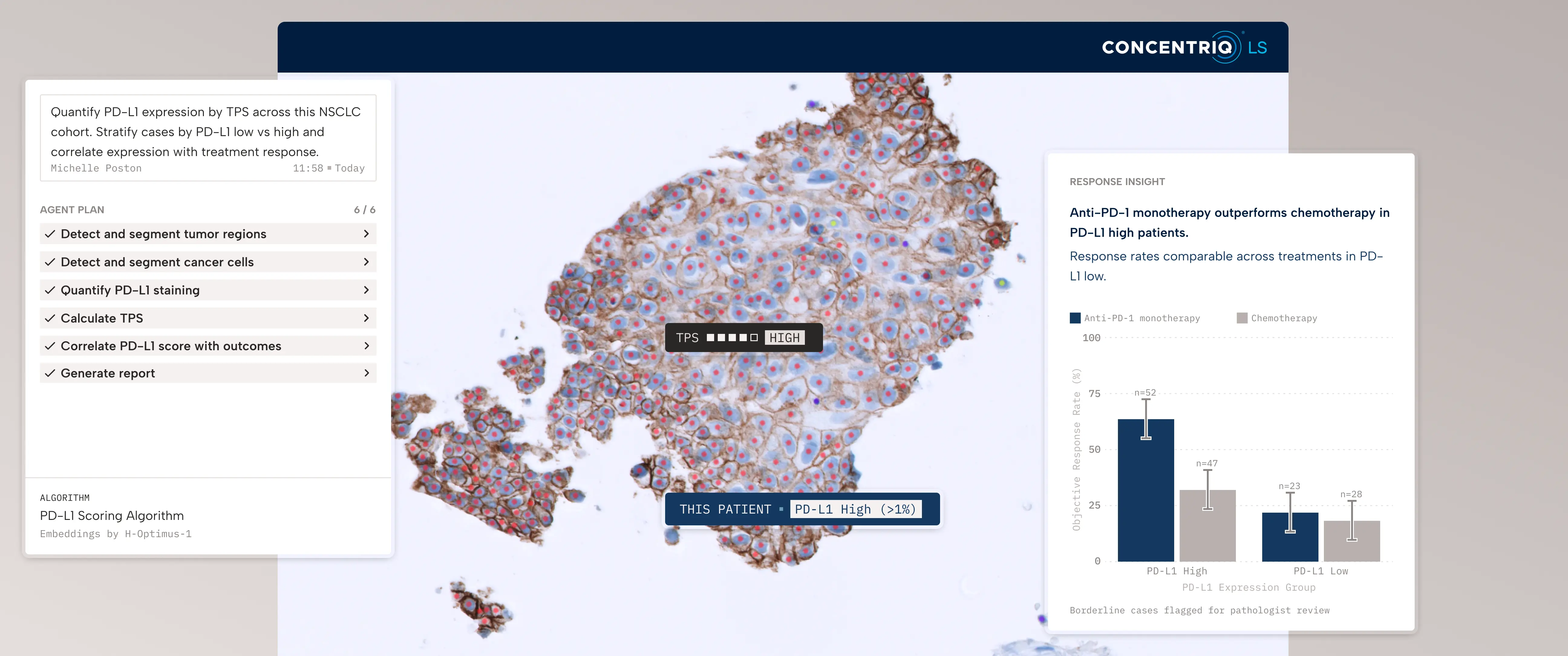
With frontier pathology models built in, agentic biomarker discovery tools let scientists test hypotheses, analyze images, and assess biomarker performance in hours, not weeks.
real-world cohorts
Interrogate biomarker algorithm performance with real-time access to diverse de-identified patient populations from a global lab network powered by Aperture, Proscia’s real-world multimodal data.
Clinical and translational data flows back into discovery, sharpening every next hypothesis. Teams and partners move faster on one searchable, intelligent, and open data layer.
“We're no longer talking about potential. We're talking about real tangible impact. We’re seeing firsthand how computational pathology on Concentriq is influencing early decision making, biomarker strategy, and even clinical trial design.”


Increase the probability of clinical trial success
Leading CROs and clinical development teams move programs forward faster, at a lower cost and risk.
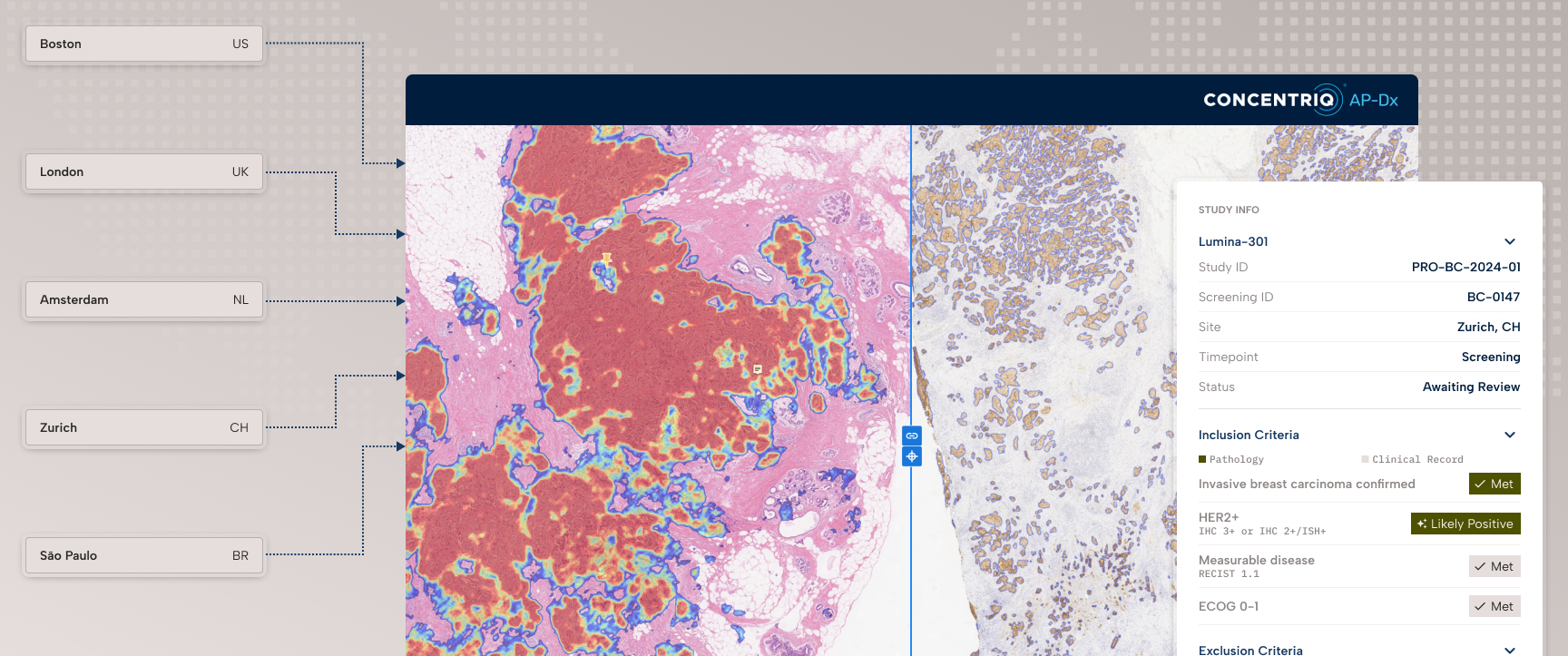
Use real-world data to characterize biomarker prevalence, model cohort feasibility, and identify the sites best positioned to recruit your population.
Centralize slides across trial sites to build consensus faster, standardize scoring with AI, and produce defensible, reproducible data.
Hit enrollment goals faster by pre-screening patients with algorithms that predict biomarker expression before expensive profiling6.
“Standardization [on Concentriq] aids in patient enrollment in clinical trials, stratification, randomization into treatment arms and endpoint evaluation.”6

IQVIA

Reach the patients your therapy is meant to find
Leverage a regulated platform and global lab network to build, validate, and deploy CDx and biomarkers into routine clinical use.
Build and validate assays
Access multimodal real-world data to iterate on assays, assess performance, and generate evidence for regulatory approval.
Deploy where patients are diagnosed
With millions of patient cases diagnosed each year across academic, reference, and health systems, Concentriq is uniquely positioned to support scalable biomarker and companion diagnostic deployment.
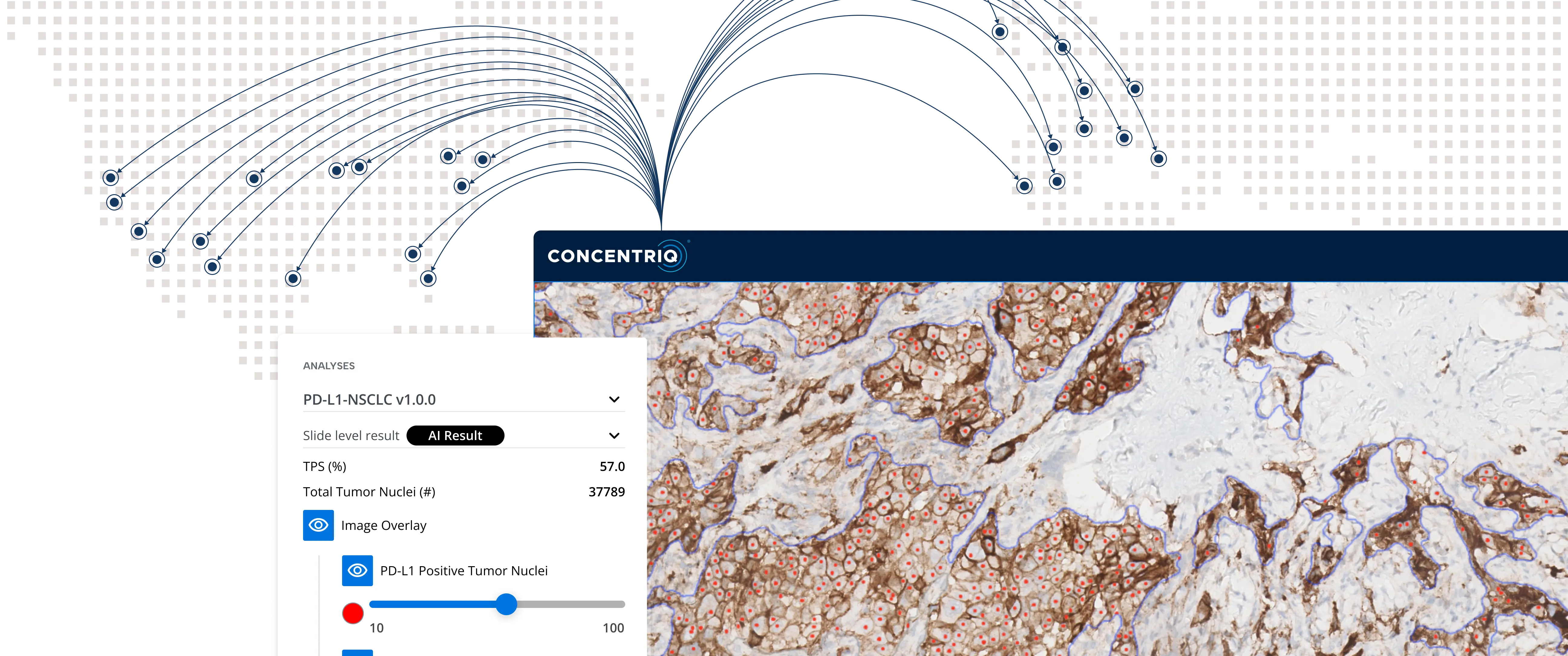
Multimodal data ready to advance your program.
Proscia Aperture brings real-world data into Concentriq as cohorts or real-time insights. Access AI-enriched tissue images, molecular, clinical, and genomic data derived from nearly 4,000 hospitals and clinics.
Specimens span the full diagnostic journey — diagnostic biopsy, surgical resection (lumpectomy and mastectomy), lymph node, and metastatic sites
Hormone receptor and HER2 status (ER, PR, HER2) for treatment stratification research
Proliferation and lineage markers (Ki-67, GATA3, E-cadherin) for tumor characterization and subtype differentiation
NGS testing available, with tumor cellularity data linked at the patient level
Specimens span the disease course — needle biopsy, TUR, radical prostatectomy, lymph node, and metastatic sites including bone
Androgen pathway and lineage markers (PSA, NKX3-1, ERG) for prostate-specific tumor characterization
PTEN and neuroendocrine markers (SYNAP, CHROMOGRANIN) for aggressive and variant disease research
NGS testing available, including TP53 and RB1 mutation status, linked to tested patients
Specimens include primary ovarian and uterine tumors, metastatic sites, and non-neoplastic tissue for comparative research
Müllerian lineage markers (PAX8, WT-1) for ovarian tumor characterization
ADC target markers (FOLRA) alongside HER2 for targeted therapy research
MMR panel (MLH1, MSH2, MSH6, PMS2) with NGS testing available, including TMB and MSI status
Specimens span the full biopsy spectrum — transbronchial, lung, and lymph node biopsies, FNA, and surgical resection
Lineage markers (TTF-1, NAPSIN, P40, CK7) for histologic subtyping
Targetable pathway markers (CMET, PD-L1) for actionable biomarker research
NGS testing available, including TMB and MSI status with a large TMB-High population
Specimens span dermatopathology and soft tissue workflows — shave, punch, excision, sentinel node, and mass biopsy
Melanocytic lineage markers (Melan-A, SOX10, HMB45) for melanoma characterization
PRAME as a diagnostic and prognostic adjunct for melanoma, with epithelial markers (AE1AE3, BEREP4) for carcinoma differentiation
NGS testing available, including a strong TMB-High population across melanoma and non-melanoma subtypes
Trusted by 16 of the top 20
pharma companies and leading CROs
Concentriq is the platform scienctis love, program managers trust, and leadership backs.







"The ultimate goal is to find the right patient for the right treatment. We are trying now to identify one that will be eligible for a specific treatment — and greatly benefit from it."

Labcorp
Built for the way life sciences works
Computational pathology designed to scale technically, operationally, and in regulated environments.
The intelligence is in the tissue
Connect with a life sciences expert to learn how Proscia can help your organization tackle modern R&D's biggest challenges.